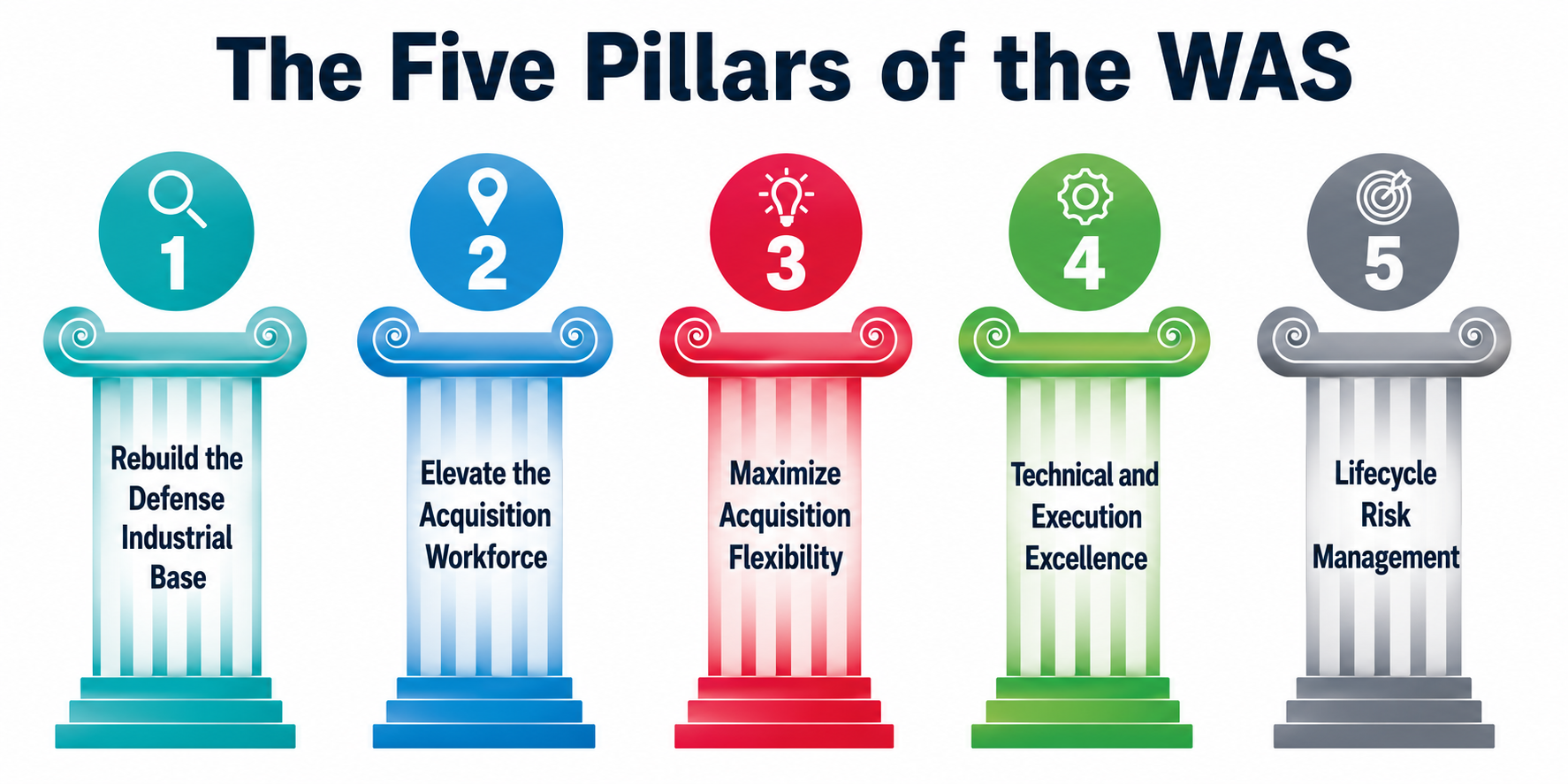
Here’s how the five pillars of the WAS change how you go to market.
First, a Little Context
In April 2025, Executive Order 14265 set the stage for a fundamental overhaul of the Department of War’s purchasing requirements. By November 2025, Secretary of War Pete Hegseth had formalized that overhaul through the Warfighting Acquisition System memoranda, officially redesignating the Defense Acquisition System as the WAS.
The old system was built around process compliance and risk avoidance. Vendors won by checking boxes, demonstrating credentials, and navigating a procurement machine that moved on a 5 to 10-year timeline.
The new system is built around one question: how do we get the best capabilities to the warfighter as fast as possible? Speed, commercial solutions, and demonstrable outcomes now outrank compliance, credentials, and lengthy proposals. This changes everything about how you need to present your company to federal buyers.
The WAS is organized around five strategic pillars. Each one carries real marketing implications for companies that pay attention.
Pillar 1: Rebuild the Defense Industrial Base
The first pillar is about expanding the supplier base beyond the legacy Big 5 prime contractors. The DoW is actively working to open direct access for non-traditional vendors and sub-tier suppliers. This includes Tier 2 and Tier 3 companies that have historically been invisible to government buyers.
What does this mean for your marketing? The playing field is opening, but only for companies that show up. Government buyers who have never looked directly at your tier before are now looking. The question is whether they can find you, and whether what they find makes a credible impression.
Non-traditional vendors and sub-tier suppliers that move now to build federal-facing visibility will have a head start that compounds over time. Companies that are waiting to see how this plays out will have to play catch-up; not a safe or smart strategy.
If you’re a domestic manufacturer, a surge-capable supplier, or a critical single-source provider and you’re not being recognized as a strategic asset, you don’t have a capability problem; you have a marketing problem.
Pillar 2: Elevate the Acquisition Workforce
The second pillar empowers program managers with longer tenures, performance KPIs tied to delivery speed, and real authority to move faster than the old system allowed. Under the WAS, PMs are incentivized to take risks on innovative vendors rather than defaulting to incumbents out of caution.
What this means for your marketing: the relationship dynamics with program managers are changing. Relationships with PM used to take years to build because familiarity was the only path to trust. Now, you can accelerate that relationship by showing up with the right capabilities at the right moment.
That makes thought leadership and direct outreach more valuable than they’ve ever been. PMs are doing more research before they engage. They’re researching and evaluating whether a company understands the problems they’re trying to solve before scheduling a meeting. Companies producing clear, substantive content about the mission areas they serve are shortening sales cycles and generating inbound interest.
Your marketing has to reach program managers before your competitors do.
Pillar 3: Maximize Acquisition Flexibility
This pillar prioritizes Other Transaction Authority (OTA) agreements and Commercial Solutions Openings (CSOs) as the preferred instruments for acquiring software, technology, and capabilities. The FAR and DFARS regulatory burden is being reduced dramatically. The Truth in Negotiations Act is being scaled back wherever competition exists.
What does this mean for your marketing? The front door to federal contracts has changed. If your business development strategy is still organized primarily around FAR-based RFPs, you’re approaching the market the slow way, through doors that are becoming less relevant every year.
OTA consortia, CSOs, and direct agency engagement are now where opportunities are being shaped and awarded. Companies that understand how these channels work and build their marketing presence around them will move faster than those still waiting for a traditional solicitation to show up on SAM.gov.
Building visibility in the right channels requires more than showing up. It requires the right message for the audience that’s actually doing the buying in those channels.
Pillar 4: Technical and Execution Excellence
The fourth pillar rewards companies that demonstrate working solutions over those that produce the best paperwork. The procurement flow has shifted from requirements-based to solutions-based.
The DoW now poses operational challenges to industry and asks for solutions. Vendors show working prototypes. The best solution wins, not the most compliant proposal.
What does this mean for your marketing? What you bring to a first meeting now determines whether there’s a second one. Your content, your website, and your capability materials all need to lead with proof, not credentials.
Government buyers in the WAS environment aren’t evaluating the impressiveness of your past performance binder. They’re evaluating whether you can solve a specific problem faster than the alternatives. Every element of your marketing needs to speak directly to that question.
This is why the language shift matters so much. Saying “we are compliant” signals the wrong thing entirely in this environment. Saying “here is our working prototype” and “here is how fast we can scale and deliver” signals exactly what the new system rewards.
Pillar 5: Lifecycle Risk Management
The fifth pillar embeds sustainment planning early and holds vendors accountable for long-term performance, not just initial delivery. Government buyers under the WAS are evaluating organizational depth, not just the solution in front of them.
What does this mean for your marketing? Buyers want to know who you are as a partner, not just what you’re selling today. Your marketing needs to convey the full picture of your organization’s capacity to support a program over time.
This is a different kind of storytelling than most GovCon companies are used to. It’s not enough to demonstrate that you can win a contract. You need to demonstrate that you can sustain it, scale it, and stand behind it. Companies that communicate that depth clearly will find it significantly easier to build the credibility that shortens the path from the first conversation to contract award.
What All Five Pillars Have in Common
Each pillar rewards a different kind of marketing behavior:
Pillar 1 = Visibility
Pillar 2 = Relationship-Building and Thought Leadership
Pillar 3 = Channel Strategy
Pillar 4 = Proof-Based Content
Pillar 5 = Organizational Depth
But here’s what’s worth noticing. Companies that align their marketing across all five don’t just check individual boxes; they compound their advantage. Being visible gets you found. Thought leadership gets you a meeting. Proof-based content gets you a second meeting. Channel presence gets you into the right solicitations early. And communicating organizational depth is what turns a good meeting into a contract.
Marketing is the force multiplier that accelerates it all. Your BD and capture teams work harder than they need to if the market doesn’t already know, like, and trust you by the time they get involved.
Where to Start
The window for repositioning in the WAS environment is open, right now. The transformation is still being implemented. Companies that build their positioning now will have relationships, track records, and credibility that late movers won’t be able to replicate quickly.
Ocean 5 has been tracking these changes since early 2026. We have built marketing programs for GovCon companies that are ready to compete in this new environment. If you want to talk through what that looks like for your organization, download the full DoW Acquisition Transformation white paper or reach out directly at [email protected].